Apollo Dash vs NAVEE NT5 Max: Which Should You Buy? (2026)
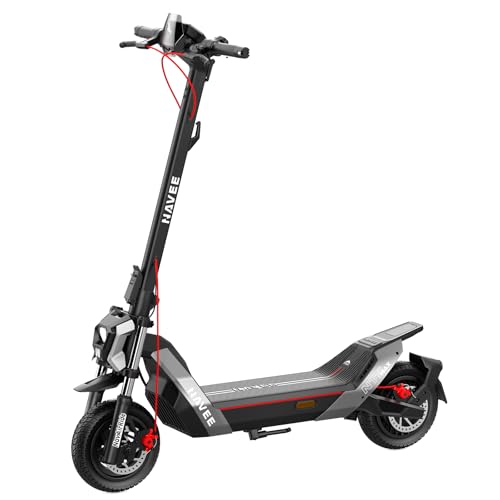
The Apollo Dash and the NAVEE NT5 Max land close enough on price and class to be genuine cross-shops — $649 against $1,000, and both sit in the commuter class. Every figure below is the manufacturer's published claim or a value we compute from it; where a maker leaves a spec unpublished we show a dash rather than guess, and a blank is never counted against a scooter. One habit to carry into any range comparison is to halve the claim. The Dash claims 25 miles but realistically returns about 14–18; the NT5 Max's 52.8-mile claim works out to roughly 29–37. The sections that follow work through where each one leads, and the verdict above already names the pick for most buyers — the detail below is there to overturn it if your priorities differ.
Side by side
| Motor & speed | ||
| Top speed (claimed) | 21 mph | — |
| Peak power | — | — |
| Nominal power | 1200 W | — |
| Drive | Single motor | Single motor |
| Max incline | 26.8% | — |
| Battery & range | ||
| Claimed range | 25 mi | 52.8 mi✓ |
| Est. real-world range | 14–18 mi | 29–37 mi✓ |
| Battery | 480 Wh | — |
| Charge time | 5 h✓ | 5.5 h |
| Build | ||
| Weight | 43 lb✓ | 73.9 lb |
| Max load | 220 lb | 331 lb✓ |
| Suspension | none | — |
| Brakes | Rear Drum + Power RBS™ (regenerative braking) | — |
| Water resistance | IP66 | IPX6 |
| Tyres | 9.5" tubeless | 10.5" tubeless |
| Features | ||
| Score (within category) | 47/100 | 62/100✓ |
| Price | $649✓ | $1,000 |

A green ✓ marks the better figure on that row. “—” means the manufacturer does not publish it; a blank is never counted as a loss. Scores compare each model within its own category.
What the makers don't publish
Apollo does not publish peak power for the Apollo Dash — 1 of the 15 specifications we track. NAVEE does not publish top speed, nominal power, peak power, battery capacity, climbing grade, suspension, and brake hardware for the NAVEE NT5 Max — 7 of the 15 specifications we track. We show a dash for each of those rather than estimate, and a missing figure is never counted against a scooter in our scoring — the component is dropped and the remaining weights renormalise. Because both sheets have holes, several rows of the table above cannot be compared at all, so treat this as a comparison of what is published rather than a complete picture. If one of the unpublished figures is the one your decision turns on, ask the seller in writing before you buy: a maker that measures a specification usually states it, and silence is a reasonable prompt to look harder.
Motor & speed
At least one of these scooters does not publish a US top speed on its official page, so we compare on power and range instead of a headline figure neither maker fully states. Read any top-speed figure as a maximum reached under ideal conditions; rider weight and gradient both pull it down in the real world, so treat these numbers as a ceiling rather than a cruising promise.
Battery & range
Both claims deserve the usual discount. The Dash's 25-mile figure realistically works out to about 14–18 miles once you account for a normal rider at real speeds; the NT5 Max's 52.8 lands at roughly 29–37. Plan around the lower end of whichever band matters to you: if your daily round trip does not fit inside it with margin to spare, the range difference here is the deciding factor and you should pick the bigger battery. Whichever you choose, remember that both figures assume a fresh battery; a pack loses roughly 20–30% of its capacity after a couple of years of daily cycling, so a used example of either will fall short of these numbers.
Build & ride
Weight is where the daily reality lives: 43 lb against 73.9 lb, a 30.9 lb difference. If you carry the scooter up stairs or onto a train, the lighter Apollo Dash is the one you will actually keep using — the difference between a scooter that gets ridden and one that gathers dust is often a single flight of steps. Each publishes a water-resistance rating (IP66 and IPX6); the higher of the two shrugs off heavier rain, though neither should be ridden through standing water or pressure-washed.
Price, score & value
The Apollo Dash is the cheaper of the two, $649 against $1,000 — a $351 gap. Whether that gap is worth closing depends entirely on whether the pricier scooter's advantages above line up with your priorities. Within their category the NAVEE NT5 Max scores higher (62/100 to 47/100). Remember that our scores are within-category judgements — this comparison is only meaningful because both sit in the same or an adjacent class. If value per dollar is your lens, use the cost-of-ownership calculator on this site: a slightly cheaper scooter with pneumatic tyres can cost more to run over a few years than a pricier one on solid tyres, and the sticker price alone hides that.
What the extra $351 buys
The NAVEE NT5 Max costs $351 more. That buys:
- claimed range: 52.8 mi vs 25 mi
- max load: 331 lb vs 220 lb
- tyre diameter: 10.5" vs 9.5"
- weight: 73.9 lb vs 43 lb
- water resistance: IP66 vs IPX6
- charge time: 5.5 h vs 5 h
It does not buy:
- voltage (both 48 V)
- tyre type (both tubeless)
- drive (both Single motor)
These two share more than they differ on. 3 published specifications are identical across both: voltage (48 V), tyre type (tubeless), drive (Single motor). That matters more than it first appears, because it narrows the decision to a short list: the 7 measures where they actually diverge — claimed range, weight, price and others — carry the whole choice. Anything on the identical list can be set aside: it will be the same experience whichever you buy, so it should not sway you either way.
Where the Dash wins
The Apollo Dash is lighter to carry (43 lb vs 73.9 lb), costs less ($649 vs $1,000), is better sealed against water (IP66 vs IPX6), and recharges faster (5 h vs 5.5 h). That is a meaningful spread of advantages, not a single headline number.
Where the NT5 Max wins
The NAVEE NT5 Max claims more range (52.8 mi vs 25 mi), takes a heavier load (331 lb vs 220 lb), and runs a larger tyre (10.5" vs 9.5"). Together those make it the stronger sheet in several areas.
What these numbers actually govern
Here is what each of these measures controls in general — both the ones that separate these two and the ones they share. These describe the measure, not a claim about how either scooter rides, which we have not tested.
- claimed range
- Every claimed range figure is measured at a light rider weight, a low constant speed and on flat ground, which is why we show a computed real-world band beside it.
- weight
- Weight decides the moments off the scooter: carrying it up a flight of stairs, lifting it onto transit, loading it into a car boot.
- price
- Price is the one figure that is not a specification — it moves with stock and promotions, so treat any gap as current rather than permanent.
- max load
- A load rating covers rider plus cargo, not the rider alone — a backpack and a week's shopping come out of the same allowance.
- water resistance
- An IP rating describes water resistance, not immersion — it covers rain and splashes, never standing water or a pressure washer.
- Tyre type (both tubeless)identical on both
- Pneumatic and tubeless tyres absorb road imperfections that solid tyres pass into the deck; solid tyres trade that comfort for never puncturing. A shared construction means the same trade on both.
- Drive (both Single motor)identical on both
- A second motor adds traction and acceleration at the cost of weight and battery drain. Where both use the same arrangement, drive layout is not a separator.
Price & where to buy
Prices are snapshots from our tracker and can change. We may earn a commission on purchases made through these links — this never affects rankings.
Prices are snapshots from our tracker and can change. We may earn a commission on purchases made through these links — this never affects rankings.
Who should buy which
Buy the Apollo Dash if you carry it up stairs or onto transit (43 lb vs 73.9 lb — a decisive 42% edge), or you want to spend less ($649 vs $1,000). Buy the NAVEE NT5 Max if your trips are longer and range decides it (52.8 mi vs 25 mi claimed — a decisive 53% edge), or you or your cargo need the higher weight limit (331 lb vs 220 lb). Whichever you pick, 3 specifications are identical across both — voltage, tyre type, drive — so those rows cannot decide it. Within their category our score puts the NAVEE NT5 Max at 62/100 against 47/100.
Bottom line: the NAVEE NT5 Max is the safer default here — it claims more range (52.8 mi vs 25 mi). The Apollo Dash earns its place if lighter to carry (43 lb vs 73.9 lb) matters more to you. Every figure here is the manufacturer's published claim or a value we compute from it, linked back to each maker's own specification so you can check it yourself.
Frequently asked questions
Is the Apollo Dash or the NAVEE NT5 Max better overall?
Within their category, the NAVEE NT5 Max scores 62/100 and the Apollo Dash scores 47/100. Our scores compare models within their own category, and the two are close enough here that your priorities — carry weight, range, price — should decide it rather than the raw number.
Which one has better real-world range?
Estimated at 55–70% of the claim, the Dash works out to about 14–18 miles and the NT5 Max to about 29–37. The one with the larger battery (480 Wh vs — Wh) holds its distance better under load.
Which is cheaper to buy?
The Apollo Dash is the cheaper of the two at $649 against $1,000. Prices are tracked snapshots and can change — check the current figure on each model's page before buying.
Which is easier to carry and store?
The Apollo Dash is lighter at 43 lb versus 73.9 lb, so it is the better pick if you carry a scooter up stairs or onto transit. Both fold for storage; weight is the deciding factor here, not folded size.
Can I ride either one in the rain?
Both publish a water rating — Dash is IP66 and NT5 Max is IPX6. Higher ratings (IPX6, IP66) handle sustained rain; IPX4–IPX5 covers light rain and splashes but not a downpour. Neither should be submerged or pressure-washed.
Full specifications and sources: Apollo Dash · NAVEE NT5 Max