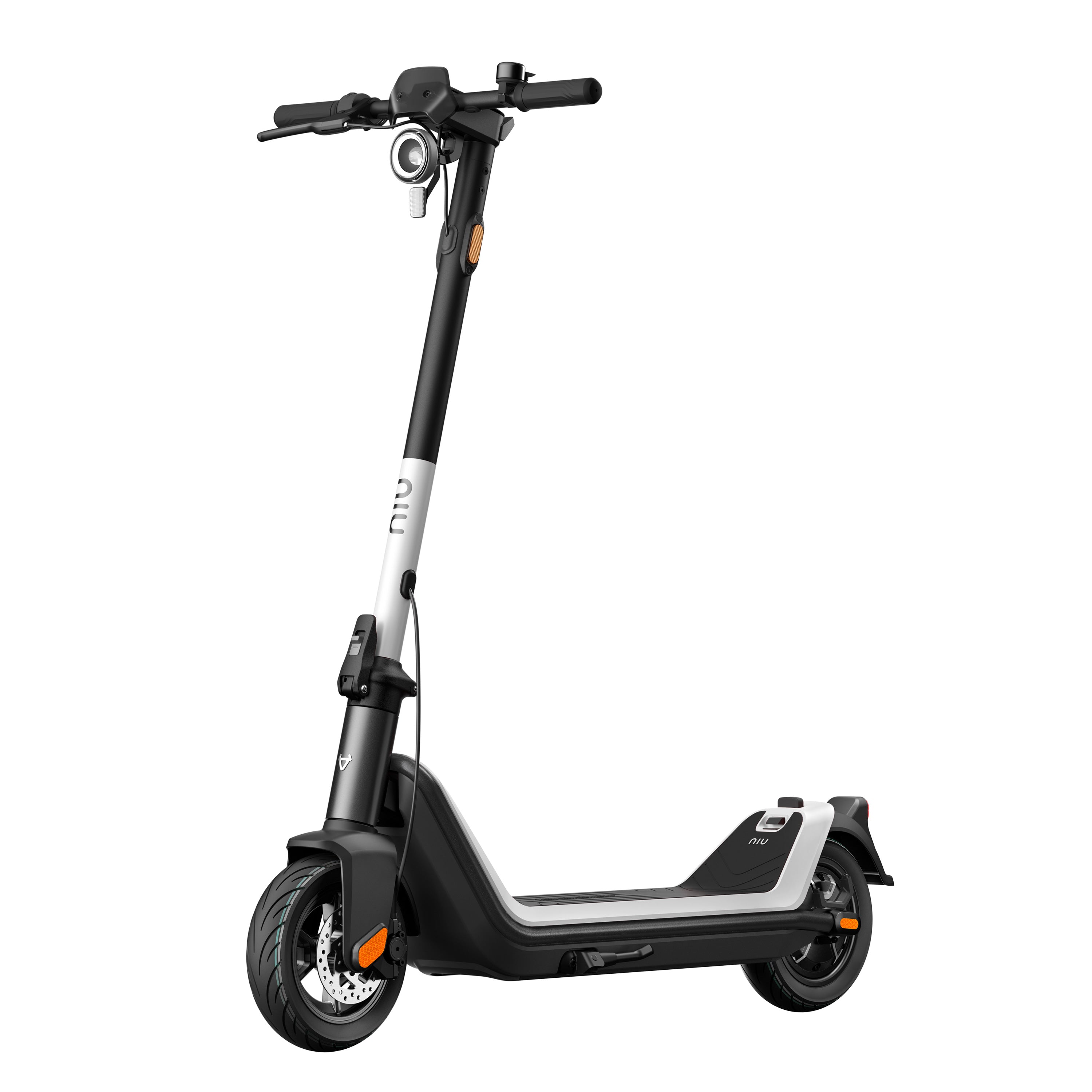
The NIU KQi3 Sport is a commuter scooter that asks $419 for a claimed 24.9 miles of range and a 17.4 mph top speed. Whether that is the right trade for you comes down to three things: how far you actually ride, how much you have to carry the scooter, and how honest you are with yourself about range.
Buy the KQi3 Sport if
Your regular round trip is comfortably under 14 miles, so you are inside the honest end of its range even on a bad day.
Budget is the priority — it undercuts the typical commuter scooter in this database.
Look elsewhere if
Your commute is close to 17 miles each way — plan around the 14–17 mile estimate, not the 24.9 mile claim.
You ride in real rain — IP54 covers splashes and light showers, not a downpour.
Your roads are rough — there is no suspension here to take the edge off.
Range: what 24.9 miles really means
NIU claims 24.9 miles. Treat that as a ceiling reached in a laboratory, not a number you will see. Manufacturers measure range with a light rider, a low steady speed, flat ground, mild weather and no wind — conditions that stack every variable in their favour. Applying our standard correction, we estimate a realistic 14–17 miles for the KQi3 Sport, and we show that band everywhere the claim appears so the two are never confused.
Rider weight. The test rider is around 165 lb. Every pound over that pulls you toward the 14-mile end.
Speed. Range collapses faster than speed rises. Cruising near 17.4 mph can cost a third of the distance versus a gentle pace.
Hills and cold. Climbs and sub-50°F weather both cut range noticeably, the latter because lithium cells deliver less when cold.
The honest way to compare range between scooters is the battery, not the claim. The KQi3 Sport carries a 365 Wh pack, which is near the bottom of the class. Watt-hours cannot be marketed around: a bigger pack out-lasts a smaller one on the same terrain regardless of what either brochure promises, and against a category median claim of 37.1 miles this model claims less than the typical model in its class.
The honest number
Plan your commute around 14–17 miles. If your daily distance does not fit inside the lower figure with margin to spare, buy a scooter with a bigger battery rather than hoping for the claim.
Motor, speed and hills
The claimed top speed is 17.4 mph, near the bottom of the class. Peak output is 600 W (300 W nominal). A single motor keeps weight and complexity down, which suits commuting more than the spec-sheet bragging rights of a second motor.
NIU rates it for a 15% incline. That is the figure to watch if your route has a real hill: an underpowered scooter does not just slow on a climb, it overheats and sags in range. This is a modest rating — steep hills will tax it, especially with a heavier rider.
Ride quality: tyres, suspension and brakes
There is no suspension, so tyre choice does all the cushioning — expect to feel expansion joints and potholes through the deck. Air-filled 9.5-inch pneumatic tyres absorb far more road buzz than solid ones.
Braking is handled by disc front + regenerative. Mechanical discs are dependable and easy to service, and fine for the speeds this scooter reaches.
Weatherproofing and build
The KQi3 Sport carries an IP54 water-resistance rating, which we score at 40 of 100 on the build metric. That covers light rain and splashes but not a genuine downpour; caught in heavy rain, get it dry rather than trusting the seal. A published IP rating is itself a good sign: manufacturers who test for water ingress put the number on the page, and its presence here means the figure was measured rather than hoped for.
The frame is rated to carry 265 lb. Stay well under that figure in practice — riding at the limit stresses the folding mechanism and further reduces range.
Living with it: weight, folding and charging
At 40.6 lb the KQi3 Sport is among the lowest in its class (the typical commuter scooter here is 49 lb). In everyday terms it is manageable but not effortless: fine for a few steps, tiring over a long carry. Weight is the specification buyers most often ignore at purchase and most often regret afterwards, so be honest about how many stairs stand between you and where the scooter lives.
It folds, which is table stakes for storing a scooter by a desk or in a car boot.
A full charge takes about 5 hours, quick enough to be topped up between rides.
The led dashboard keeps speed, mode and battery in view.
Safety, certification and the fine print
NIU states the KQi3 Sport is UL2272 certified, the standard that covers the electrical and battery system against fire risk. It is the single certification worth insisting on: a scooter that is not UL2272 listed is one many apartment buildings, universities and insurers will not allow indoors, and it is the difference between a battery that has been tested to a recognised safety bar and one that has not.
The 265 lb load rating is a limit, not a target. Riding at or above it stresses the deck and folding joint and measurably shortens range, so leave headroom.
Whatever the top speed, a scooter is a vehicle that can hurt you. Treat a helmet as part of the purchase, not an afterthought, and remember that the speed and range figures above were set in conditions far kinder than a real street.
Local rules on where and how fast you may ride vary by state and city and change often. We do not publish legal guidance, so check the regulations that apply where you ride before your first trip.
Charging and battery longevity
A full charge takes about 5 hours from the standard charger, quick enough to recover meaningfully during a work day. If charge speed matters to you, ask whether a faster charger is offered, but weigh it against battery life: fast charging generates heat, and heat is what ages lithium cells.
Whatever the 365 Wh pack, how long it lasts is mostly in your hands. Lithium batteries prefer to live between roughly 20% and 80% of charge; draining to empty and leaving it there, or storing it fully charged in a hot space, are the two habits that shorten a scooter's usable life the fastest. With the battery built in, treating it gently is the difference between a scooter that holds its range for years and one that fades in a season.
What it costs to own
The sticker price is $419, but the number that matters is what it costs to keep. Over two years we estimate a total of $578 once you add electricity (roughly three charges a week at the US average rate) and consumables such as tyres, tubes and pads. That is an estimate for comparing models on the same basis, not a quote — but it reframes a cheap scooter with pneumatic tyres against a pricier one that may cost less to run.
Against a category median of $699, the KQi3 Sport is priced aggressively — its value score reflects strong specification-per-dollar.
How the NIU KQi3 Sport compares in its class
We rank the NIU KQi3 Sport against every other commuter scooter in the database on the same five measures — range, power, build, portability and value — each scored within the category so it competes with true peers rather than machines from a different price bracket. Its overall score is 33/100.
NAVEE GT5 Max — 77/100, $800, 55.9 mi claimed. Scores higher overall — worth a look before you commit.
NAVEE ST5 Max — 77/100, 55.9 mi claimed. Scores higher overall — worth a look before you commit.
NAVEE XT5 Max — 72/100, 68.4 mi claimed. Scores higher overall — worth a look before you commit.
The comparison table on each ranking page lets you sort these side by side on whichever specification actually decides your purchase.
The verdict
The NIU KQi3 Sport earns its place for a large battery for its class, an aggressive price, and its main compromise is no suspension. It is a considered pick for a specific buyer rather than a blanket recommendation. As always, every figure above is NIU's published claim or a value we compute from it, linked back to the manufacturer's own page so you can verify any number yourself.
Full specifications
Figures the manufacturer does not publish are shown as “—”. We do not estimate them.
Motor & speed
Specification
Value
Top speed (claimed)
17.4 mph
Nominal motor power
300 W
Peak motor power
600 W
Drive
Single motor
Max incline
15%
Battery & range
Specification
Value
Claimed range
24.9 mi
Estimated real-world range
14–17 mi
Battery capacity
365 Wh
Voltage
—
Capacity
—
Charge time
5 h
UL2272 certified
Yes
Build
Specification
Value
Weight
40.6 lb
Max rider load
265 lb
Tyres
9.5" pneumatic
Suspension
none
Brakes
Disc front + regenerative
Water resistance
IP54
Foldable
Yes
Features
Specification
Value
Display
LED dashboard
App support
—
Apple Find My
—
Turn signals
—
Pros & cons
Derived from the published specifications above.
Pros
+Manufacturer states UL2272 certification
Cons
−Only IP54 sealing — light rain at most
−No suspension
How we scored it
9
Range
8
Power
38
Build
85
Portability
54
Value
Scores are percentile-ranked within the Commuter category, weighted 25/25/20/15/15 over whichever components are published. A component we cannot compute is dropped and the weights renormalise — never scored as zero. Read the full method.
Scores compare models within their own category. A budget scooter's 90 and a performance scooter's 90 are not directly comparable.
Where this scooter is street legal
This model's published specification fits the statutory definition of a street-legal scooter in 12 of the 17 states we have verified against the statute and exceeds the definition in 1.
Falling outside a definition does not make a scooter illegal to own. It means the permissions written for that device class — bike-lane access, no registration, no insurance — do not apply to it as sold.
Hiboy S2 MAX pairs a claimed top speed of 19 mph, a claimed range of 40 miles, a 557 Wh battery. Best suited to commuters comparing specifications directly.
What is the real-world range of the NIU KQi3 Sport?
NIU claims 24.9 miles. Manufacturers measure range at about a 165 lb rider, a low constant speed and on flat ground, so we estimate a realistic 14–17 miles. Heavier riders, hills, cold weather and higher speeds all push you towards the lower end.
How fast is the NIU KQi3 Sport?
The manufacturer's claimed top speed is 17.4 mph. That figure is measured under favourable conditions; rider weight and gradient both reduce it in practice.
Can you ride the NIU KQi3 Sport in the rain?
It carries an IP54 water-resistance rating. That covers light rain and splashes but not heavy standing water.
How much does the NIU KQi3 Sport weigh?
It weighs 40.6 lb and is rated to carry up to 265 lb. Anything above roughly 50 lb is difficult to carry up stairs or lift onto public transport regularly.
Is the NIU KQi3 Sport worth the price?
It currently tracks at $419. Our value score compares its range, power, build and portability against other Commuter models at their current prices, so it rewards specification per dollar rather than a low price alone. Check the price history above before buying — we track it over time.